A year ago, when someone in India wanted to find a photographer, a boutique, or a website designer, they opened Google. Today, a growing share of that same audience opens ChatGPT, Perplexity, or Google Gemini, types the question in plain English, and reads whatever the AI hands back. They don't click through ten blue links anymore, they act on the two or three businesses the AI decides to name.
If your business isn't one of those names, you don't exist in that conversation. This is why GEO, Generative Engine Optimization, has become the most important SEO shift since mobile-first indexing.
What Exactly Is GEO?
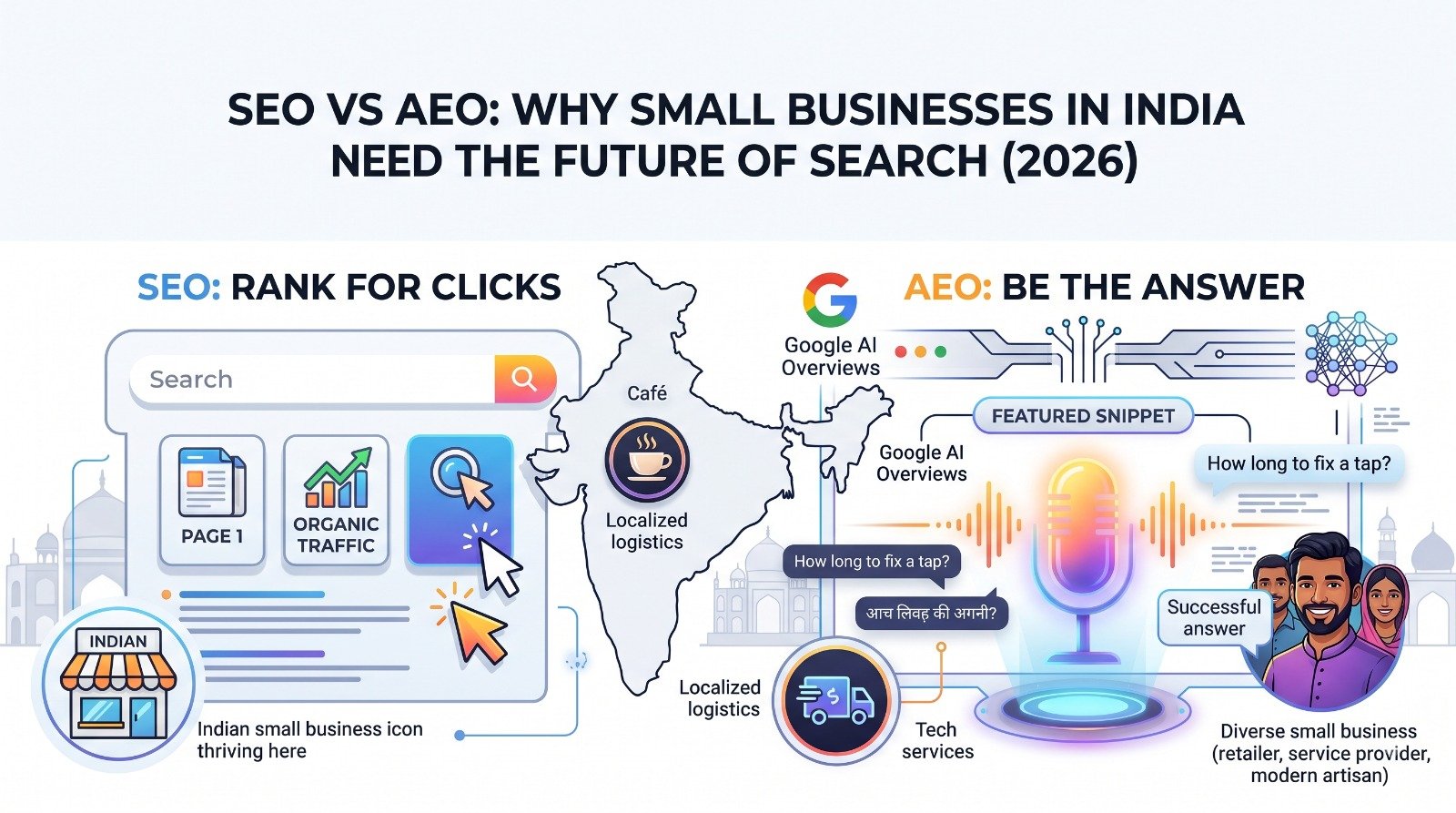
GEO is the practice of structuring your website and online presence so that AI assistants cite your business when users ask them related questions. Where SEO tries to get a click, GEO tries to get a mention. When ChatGPT tells someone "a good option in Pune is Vistrix Studio," that mention is worth more than a first-page Google ranking, because the user has already accepted the AI's recommendation.
The AI systems that matter for Indian small businesses right now are:
- ChatGPT (OpenAI), the largest consumer AI assistant, with real-time web search enabled by default
- Perplexity, search-first AI that always cites its sources, popular with researchers and buyers
- Google Gemini, deeply integrated with Google Search, Maps, and Business Profiles
- Claude (Anthropic), used inside many tools and apps you may already be visible in
- Google AI Overviews, the AI-generated summary above regular search results
"SEO fought for the first link. AEO fought for the featured snippet. GEO fights for the sentence itself, the exact words the AI says out loud to your future customer."
SEO vs AEO vs GEO, The Full Picture
These three aren't replacements for each other. They're layered, you need all three to be visible across the full search journey in 2026.
| Aspect | SEO | AEO | GEO |
|---|---|---|---|
| Goal | Rank on Google | Own the answer box | Get cited by AI |
| Where it shows | Search results | Featured snippets, PAA | ChatGPT, Perplexity, Gemini |
| User action | Click your link | Read Google's answer | Trust the AI's recommendation |
| Signal type | Backlinks, keywords | Structured Q&A, schema | Mentions, authority, freshness |
| Competition in India | Very high | Medium | Very low (opportunity) |
Why GEO Matters Right Now for Indian Small Businesses
Three things are converging that make this the exact right moment for Indian small businesses to invest in GEO:
1. The buyer journey has shifted to AI first
Founders, marketers, and buyers under 40 increasingly start research inside ChatGPT or Perplexity instead of Google. They ask "best social media agency for a D2C brand in Pune" and expect a shortlist, not a list of blue links to filter. If your business isn't in the shortlist the AI hands back, you're invisible at the top of the funnel.
2. Almost no Indian competitor is optimizing for it yet
Most local competitors are still figuring out basic SEO. AEO is only starting to catch on. GEO is a wide-open playing field in India right now, the businesses that move in the next 6 to 12 months will lock in position before it becomes crowded.
3. AI systems reward locally specific, well-structured content
Large language models are trained to pull answers from sources that are clear, factual, and specifically written for a real question. This favours small businesses that write honestly about what they do, for whom, and in which city, over generic global brands that speak in vague terms.
The 4 Signals AI Assistants Use to Pick Who They Cite
AI systems don't rank pages the way Google does. They pull content into a working memory and decide which sources are worth quoting. From what we've observed across ChatGPT, Perplexity, and Gemini, four signals dominate:
Signal 1: Structured, question-answer content
AI models heavily favour content organised as clear questions with direct, quotable answers. FAQ pages, "How to" articles, and comparison tables are extracted more often than long narrative blog posts. If you can be quoted in one clean sentence, you're ahead.
Signal 2: Mentions on trusted third-party sites
AI systems use "co-citation", the more your business name appears alongside your service and city on independent websites (industry directories, news sites, review platforms, aggregator listings), the more the AI trusts you as a real, notable business in that category. This is why appearing on Justdial, Sulekha, IndiaMART, and industry-specific directories still matters, AI training data ingests them.
Signal 3: Freshness and recency
Real-time AI search (ChatGPT with browsing, Perplexity, Gemini) prefers content that was recently updated. A page updated three months ago beats an identical page from 2022. Refreshing your top pages every 3-6 months keeps you in the AI's live index.
Signal 4: A crawlable, AI-friendly site
If your robots.txt blocks AI crawlers, or your site relies heavily on JavaScript-only rendering, AI systems can't ingest your content. Many small business sites, especially those built on outdated CMS platforms, accidentally block themselves from being indexed by GPTBot, PerplexityBot, and Google-Extended.
Not sure if AI assistants can even find your website?
Vistrix Studio's free Digital Health Audit now includes a GEO readiness check, we verify your robots.txt, structured data, freshness signals, and third-party citations, and tell you exactly where you're invisible to AI systems.
Get Your Free GEO Audit →6 Practical Steps to Start Optimizing for GEO
You don't need a big budget or a technical team. These are the six actions we run for every Vistrix Studio client, and any small business in India can start today.
Step 1: Allow AI crawlers in your robots.txt
Open your robots.txt file and explicitly allow the major AI crawlers. If you don't have this file, your web team can add it in minutes. Here's the block that should be present:
User-agent: GPTBot
Allow: /
User-agent: PerplexityBot
Allow: /
User-agent: Claude-Web
Allow: /
User-agent: anthropic-ai
Allow: /
User-agent: Google-Extended
Allow: /
Every page on the Vistrix Studio site already has this, you can view our own robots.txt here as a reference.
Step 2: Add FAQ schema to every important page
Wrap your most common customer questions in FAQPage JSON-LD schema. This is the single most extract-friendly structure for AI. Google, ChatGPT, and Perplexity all read this schema directly. If you're on WordPress, plugins like Rank Math handle it. If your site is custom-built, ask your developer to add a JSON-LD script to your service pages.
Step 3: Get listed on the aggregators AI systems actually read
For Indian small businesses, the highest-ROI directories to appear on are:
- Google Business Profile (fully filled, verified, with recent posts and reviews)
- Justdial and Sulekha (both are ingested into major AI training sets)
- IndiaMART if you sell products or services B2B
- Industry-specific directories, for example Clutch or DesignRush for agencies, Zomato for restaurants, UrbanCompany profiles for services
- LinkedIn Company Page, heavily used by ChatGPT and Perplexity when answering business questions
Step 4: Publish "listicle" and comparison content
AI systems love extractable list formats. Content like "Top 5 web design agencies in Pune" or "Best social media services for D2C brands in India" gets pulled apart cleanly and cited often. Write these honestly, include yourself when you legitimately belong on the list, and the AI will surface you when someone asks a similar question.
Step 5: Establish a real presence on Wikipedia-adjacent sources
You may not be big enough for a Wikipedia page yet, but mentions in sources Wikipedia and AI systems trust, Crunchbase (for startups), a Medium publication, a guest post on a well-known industry blog, or a mention in a news article, carry heavy weight. One good third-party mention is worth ten of your own blog posts.
Step 6: Refresh your top pages every quarter
Pick your five most important pages (homepage, top service pages, top blog posts) and update them every 3 months. Change dates, add a new paragraph, refresh statistics, tweak examples. AI systems favour recent content, a stale page from 2023 gets skipped even if it's the best-written one on the topic.
How to Check If AI Is Already Citing You
You don't need paid tools to test this. Open a fresh ChatGPT or Perplexity session (no login history) and run these prompts, substituting your city and industry:
- "What are the best [your service] providers in [your city]?"
- "Recommend a [your service] agency in India for a small business."
- "Compare top [your service] studios in [your region]."
- "Who does [your specific niche] for D2C brands in India?"
If your business is mentioned by name, you have baseline GEO presence, now optimise. If your competitors are mentioned but you aren't, you have a specific gap to close. If nobody in your city is mentioned, the field is wide open and your first-mover advantage window is right now.
"The best time to invest in GEO for your Indian small business was six months ago. The second-best time is this week, before your competitors realise the opportunity exists."
Where This Is Heading
Search is fragmenting. Google is no longer the single front door to the internet. Every day, more buyers reach for an AI assistant instead. For small businesses in India, this is either a threat, silently losing visibility as your traditional SEO stops delivering, or an opportunity: showing up in the very first, most trusted layer of your future customer's research process.
SEO, AEO, and GEO aren't three separate initiatives to run in sequence. They're three layers of the same modern visibility strategy. Start with the foundations, layer in structured content and schema, and open your site to AI crawlers. Do this now and you'll be visible when the AI shift becomes universal, not scrambling to catch up.
If you'd like an honest, category-by-category read of where your business currently stands across SEO, AEO, and GEO, book a free Digital Health Audit from Vistrix Studio. We'll deliver a full report, with specific fixes, within 24 hours.