Every few months a founder asks us the same question, sometimes politely, sometimes bluntly: "Do we really need a website in 2026? Everyone's on Instagram now. Isn't that enough?"
It's a fair question. Instagram, WhatsApp, YouTube, and Google Maps together do a lot of the work a website used to. For some businesses, that combination genuinely is enough to get started. But if you're serious about building a brand, not just running a business account, a website still plays a role that no social platform can replace. And in 2026, that role has gotten more important, not less.
The Rental vs Ownership Problem
Here's the single most important thing to understand: your Instagram, Facebook, YouTube, and Google Business Profile are all rentals. You do not own them. You do not control their rules. You cannot take them with you.
Instagram can suspend your account without warning or clear explanation. It has happened to real Indian small businesses in the last twelve months, sometimes for algorithm mistakes the account never appealed successfully. Facebook can shift its feed algorithm overnight and cut your organic reach by 70% without you doing anything wrong. WhatsApp Business can restrict your broadcast lists. YouTube can demonetise or hide a channel. Even Google Business Profile can be suspended if a competitor mass-reports it.
Every business built entirely on rented land is one platform decision away from disappearing. A website, hosted on a domain you own, is the one asset that cannot be taken from you. If your host disappears, you move to another one. If your domain provider changes rules, you transfer to another. Your website comes with you.
"On Instagram, you're a tenant in someone else's building. On your website, you're the owner. Both matter, but only one is permanent."
The First Impression Still Happens on Google
When someone hears about your business, whether from a friend, an ad, a Reel, or a WhatsApp forward, the very next thing they do in India in 2026 is Google your business name. What comes up in that search determines whether they take you seriously.
Without a website, the top result is usually your Instagram or Facebook profile, which was built to be scrolled, not scrutinised. Serious buyers who want to check pricing, credentials, past work, or contact details often bounce right there. A well-built homepage answers all those questions in fifteen seconds, and it does so on your terms with your branding, your language, and your best case forward.
The same logic now applies to AI search. When someone asks ChatGPT, Perplexity, or Google Gemini "what's a good [your service] in [your city]," the assistant pulls from indexed websites, structured content, and third-party citations. Instagram posts and Reels are largely invisible to that layer. If you want to show up in the AI-answer era, you need a website. We wrote more about that in our GEO article.
A Website Gives Your Brand Full Creative Control
On Instagram, your brand looks like every other brand's Instagram. Same grid, same layout, same fonts, same interaction model. You can pick your palette and photography style, but the container is fixed and it flattens everyone into a common format.
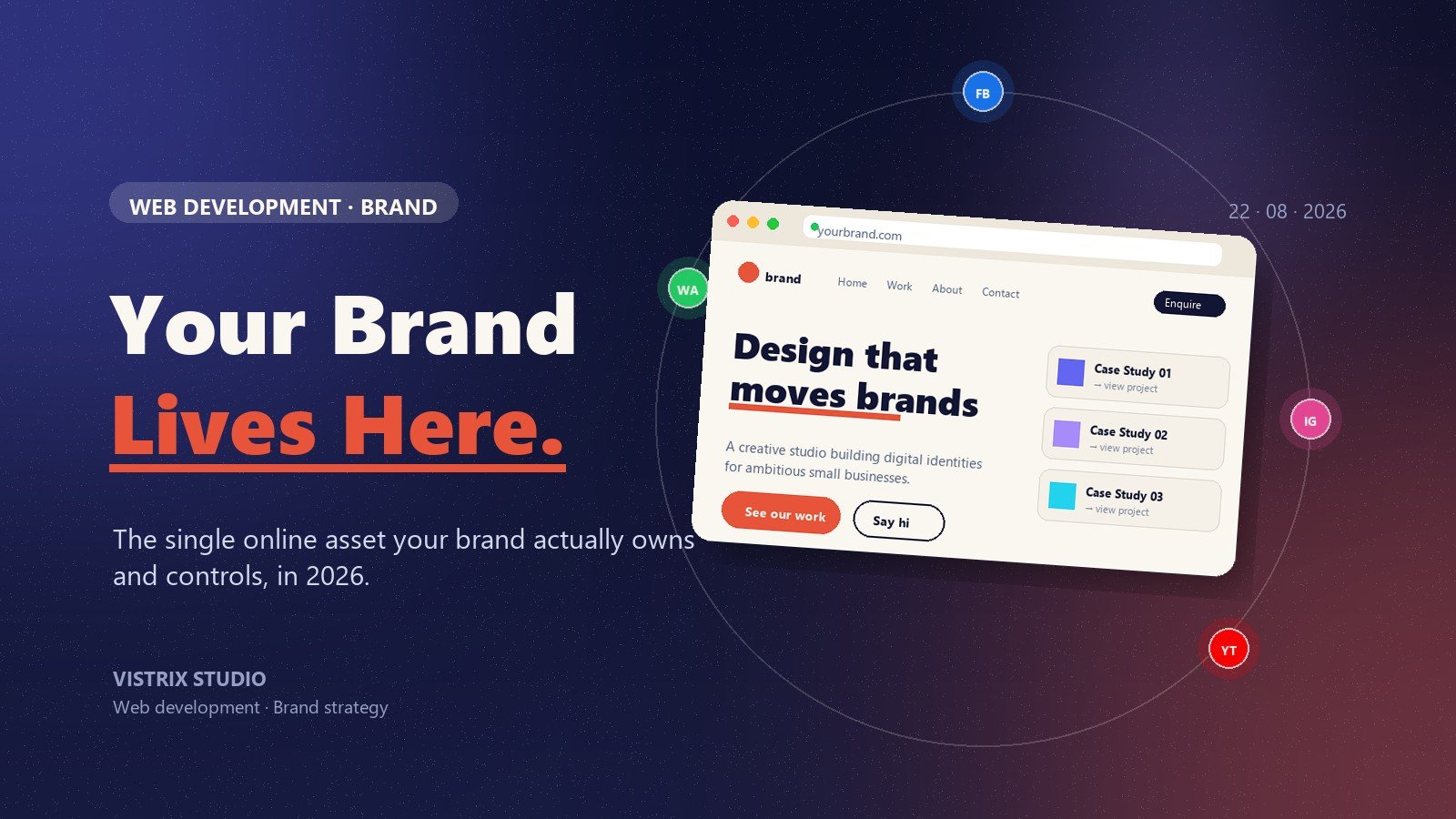
A website is the one place online where your brand's identity can be fully expressed. Layout, typography, colour, imagery, motion, voice, sequence, everything can be tuned to reinforce who you are and who you serve. That control is not a nice-to-have. It's how brands become distinctive rather than interchangeable.
What full control lets you do that Instagram cannot:
- Tell a longer, non-linear story about your work with photography, video, case studies, and testimonials in one considered flow
- Present pricing clearly instead of "DM for price"
- Show credentials, awards, certifications, and press mentions in a hierarchy that builds trust in the right order
- Offer a proper enquiry form that captures the fields you actually need, not just a WhatsApp reply
- Build a real content archive: guides, resources, blog articles that people find months and years later on Google
- Design a customer journey from discovery to enquiry that measures every step
The Real Comparison: Instagram, WhatsApp, Website
The mistake is thinking of these as alternatives. They're not, they play different roles. Here's the honest comparison for a small brand in India in 2026:
| Function | Website | ||
|---|---|---|---|
| Awareness & audience growth | Excellent | Weak | Weak on its own |
| Conversations & conversion | Fair | Excellent | Good with a form |
| Credibility & trust | Limited | Very limited | Strong |
| Google & AI discovery | Minimal | None | Primary source |
| Ownership | Rented | Rented | Owned |
| Analytics & measurement | Basic | Basic | Deep |
| Longevity of content | 24-72 hours | Instant only | Permanent |
Read the table again and it becomes obvious: these three tools do different things. A brand that treats them as a system, Instagram to grow audience, website to build credibility and rank, WhatsApp to convert conversations, will always outperform a brand relying on any one alone.
Not sure if your current setup is doing the job?
Vistrix Studio's free Digital Health Audit checks your website, Instagram, Google Business Profile, and AI visibility in one report, so you can see exactly where your brand is strong and where it's leaking.
Get Your Free Brand Health Audit →Content on a Website Compounds. Content on Instagram Evaporates.
A Reel gets its lifetime reach in the first 48 to 72 hours. An Instagram post rarely surfaces beyond a week. A Story is gone in 24 hours by design. All of your effort on those platforms is essentially rented, temporary attention.
An article you publish on your website is different. If it answers a question people actually search for, it can drive traffic for years. Every article you add strengthens your Google authority and gives AI assistants more surface area to cite you. Every case study you publish becomes a permanent proof point future customers find during their research. The compounding here is not marginal, it's the entire long-term growth story for most small brands.
"Instagram grows the audience you have this month. A website builds the audience you'll have five years from now."
What a Brand Website Should Actually Do in 2026
A website is not just a business card. If it is, you're leaving 80% of its value on the table. Here's what a properly built brand website does in 2026:
1. Loads fast, on mobile, always
75% of your visitors are on mobile phones on 4G or 5G. If the site takes more than 3 seconds to load, more than half of them leave. Speed is the single biggest technical thing that separates brands people trust from brands they abandon.
2. Communicates who you are in the first fold
Above the fold on the homepage: who you are, who you serve, what specific outcome you deliver, and what to do next. If a visitor cannot get those four things in five seconds, the design is failing.
3. Shows proof, not just promises
Real photography of real work, named customer testimonials, specific case studies with numbers, Google review count, past client logos. Anyone can promise. Only brands with proof close.
4. Makes contact effortless
A clear enquiry form, WhatsApp click-to-chat, phone number as a tap-to-call link, direct email, all above the fold or one tap away on every page.
5. Includes structured content for AI and search
FAQ sections with schema markup, blog articles that answer real customer questions, meta tags done right, a sitemap, and a robots.txt that allows both traditional and AI crawlers. This is what gets your brand cited by Google, ChatGPT, Perplexity, and Gemini.
6. Reflects the brand, not a template
Custom design, custom typography, custom imagery. Not a Wix template that ten other businesses in your city are also using. This is where craft actually matters and where cheap "quick websites" fail.
Two Common Objections, Answered Honestly
"But I get all my leads from Instagram, so why bother?"
You get leads from Instagram until you don't. When the algorithm shifts, or your account gets temporarily restricted, or you want to grow beyond what Instagram organically allows, you'll wish you had another source. Build the website while things are going well, not after they aren't.
"Websites are expensive and I'm not sure it's worth it."
A properly built small business website in India starts at around INR 15,000. That's less than a single mid-tier smartphone. And unlike a phone, it works for you 24 hours a day, forever, without a recurring monthly fee. If a single new customer from your website is worth INR 15,000 in lifetime revenue, and for most service brands they are worth many multiples of that, the site pays for itself in weeks.
The Real Question Isn't Whether You Need One
The real question isn't whether your brand needs a website. It's whether you want to build your brand on land you own or on land you rent.
Both have a place. Instagram is a great growth channel. WhatsApp is a great conversation channel. But the brand itself, the identity, the credibility, the permanent home for everything you've built, that needs its own address on the internet. In 2026, more than ever.
If you're ready to build a website that actually reflects your brand and drives real business, talk to us. Or if you already have a site and want an honest read on how well it's doing the job, get a free Digital Health Audit, a full report within 24 hours.