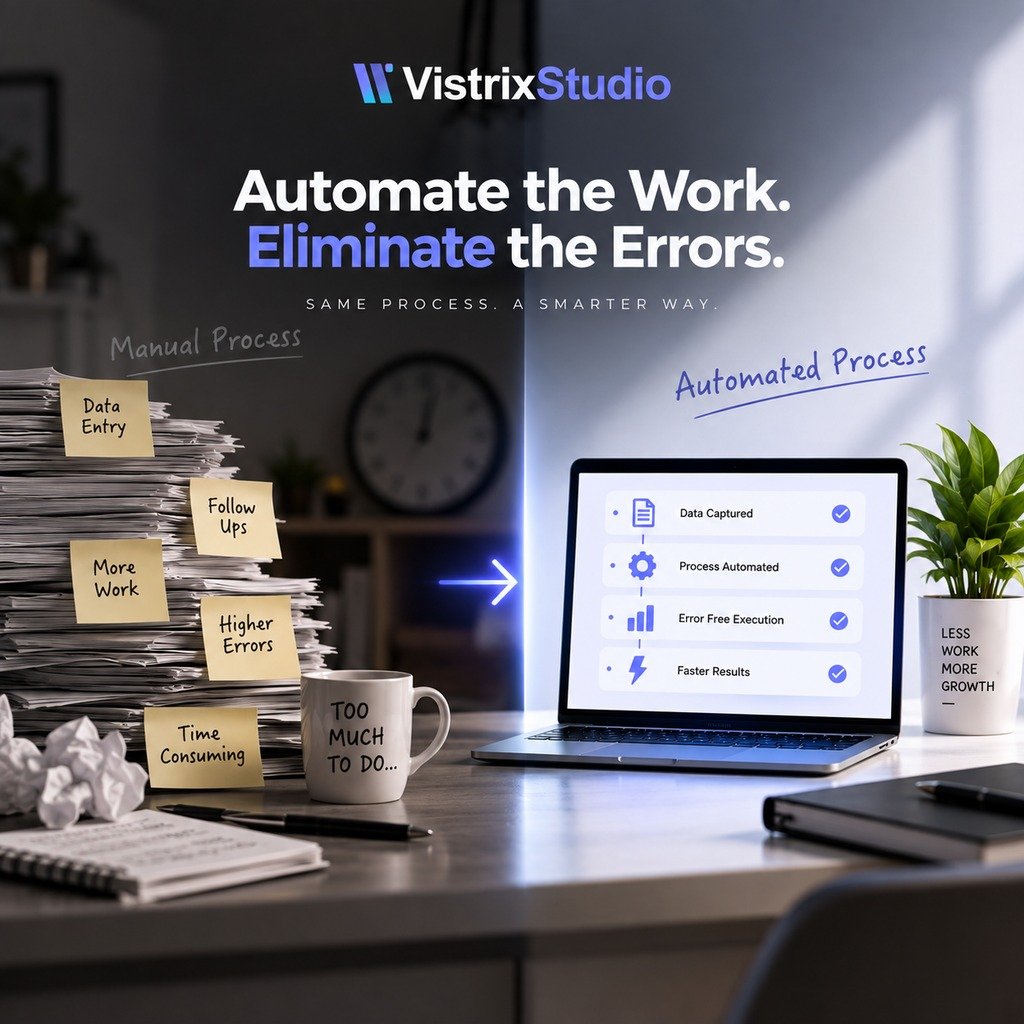
Nobody starts a business to copy phone numbers from one app into another. Yet if you added up the hours a typical small business spends re-typing enquiries into a spreadsheet, chasing unpaid invoices over WhatsApp, and reminding customers about tomorrow's appointment, you would be looking at most of a working day every week.
The cost is not only the time. Manual work fails quietly. A number gets typed wrong, a follow-up is forgotten on a busy afternoon, an invoice goes out with last month's date. Each mistake is small, and each one costs either a customer or an hour of unpicking it.
This guide is about deciding what to hand over to software, in what order, and what it realistically costs.
The Real Cost of Doing It Manually
The strongest argument for automation is rarely the time saved. It is consistency. Software does the same thing on a Monday morning as it does at 8pm on a Saturday when you have twelve other things happening.
Put differently: your manual process is at its weakest precisely when your business is at its busiest. Automation removes that correlation.
The question is not "can this be automated?" Almost anything can. The question is "what breaks most often when we are busy?" Start there.
What to Automate First: A Three-Question Test
Before buying any tool, run each recurring task through three questions. A task worth automating answers yes to all three.
- Is it repetitive? You do it more than a few times a week in essentially the same way.
- Is it rule-based? You could write the steps down and someone else could follow them without judgement calls.
- Does failure cost something? Forgetting it loses a customer, delays payment, or creates work to fix.
Tasks that fail the second question — anything needing real judgement, taste, or a relationship — should stay human. Automating a task that genuinely requires thought produces confident, fast, wrong output.
Five Automations Worth Setting Up This Month
These are ordered by how often we see them pay off for small businesses in India, not by how impressive they look.
1. Lead capture and first response
The single highest-return automation for most businesses. An enquiry that sits unanswered for six hours is often an enquiry that went to a competitor who replied in six minutes.
At minimum, your website enquiry form should land somewhere you actually watch — email plus a spreadsheet row, not a form inbox nobody opens — and trigger an instant acknowledgement so the customer knows they reached a real business. WhatsApp Business greeting messages and away messages do this for free.
2. Payment reminders and invoicing
Chasing payments is uncomfortable, which is why it gets postponed, which is why cash flow suffers. Software has no such reluctance.
Payment gateways and accounting tools used widely in India — Razorpay, Zoho Books, Vyapar, Khatabook — will generate an invoice, attach a payment link, and send scheduled reminders until it is paid. Set the reminder cadence once and stop thinking about it.
3. Appointment and booking reminders
For clinics, salons, studios, and consultants, no-shows are pure lost revenue. An automated reminder the evening before and again two hours prior reliably cuts them. Most booking tools include this, and for smaller volumes a WhatsApp Business broadcast or a shared Google Calendar with notifications covers it.
4. Data entry between tools
This is the paperwork stack in the picture above — moving the same information between a form, a spreadsheet, an invoice, and a customer record. If you are typing the same detail into more than two places, connect them instead.
Google Forms writing directly into Sheets is free and solves a surprising share of this. For anything more involved, connector tools such as Zapier and Make link apps that have no native integration, usually without writing code.
5. Content and social scheduling
Posting consistently matters more than posting often, and consistency is exactly what slips when work gets busy. Scheduling a fortnight of posts in one sitting protects the habit. Meta Business Suite does this at no cost for Facebook and Instagram.
Not sure where your process is leaking?
Our free Digital Health Audit reviews how enquiries reach you, how quickly your site responds, and where your online presence is losing people — across SEO, performance, security, and content. Detailed report within 24 hours.
Get Your Free Audit →Where the Hours Actually Go
A rough picture of what these tasks cost a typical small business in a week, and what is realistically recoverable. Treat the numbers as a prompt to measure your own, not as a benchmark.
| Task | Typical week | After automating | What you gain |
|---|---|---|---|
| Replying to first enquiries | 3–5 hrs | 1–2 hrs | Instant response; fewer lost leads |
| Invoicing and chasing payment | 2–4 hrs | Under 1 hr | Faster payment, no awkward reminders |
| Appointment reminders | 1–2 hrs | Near zero | Fewer no-shows |
| Re-typing data between apps | 2–4 hrs | Near zero | Removes transcription errors |
| Scheduling social content | 2–3 hrs | 1 hr | Consistency during busy weeks |
Where Automation Goes Wrong
- Automating a broken process. If the follow-up message is badly written, automation sends a badly written message to everyone, faster. Fix and write down the manual version first.
- Removing the human from moments that need one. Complaints, refunds, and high-value enquiries should reach a person quickly. An auto-reply to an unhappy customer makes things worse.
- Buying tools before mapping the process. Subscriptions accumulate and overlap. Write the steps out on paper first; you will often find the fix needs no new tool at all.
- Nobody owning it. Automations break silently when an app changes or a password expires. Someone should check monthly that messages are still going out.
- Automating everything at once. Change one process, let it run for two weeks, confirm it works, then move to the next.
A Realistic Place to Start
You do not need a budget or a developer to begin. You need one process, written down.
- Pick the task that most often gets forgotten when you are busy
- Write out its steps exactly as they happen today, including the messy parts
- Identify which steps are purely mechanical — no judgement required
- Automate only those steps, using tools you already pay for where possible
- Run it for two weeks and check the output yourself before trusting it
- Then, and only then, pick the next process
The businesses that get real value from automation are rarely the ones with the most sophisticated setup. They are the ones who fixed the single process that kept costing them customers, confirmed it worked, and moved on to the next one.
If your enquiries arrive through your website, that is usually the right place to start — and it is worth making sure the site itself is not the bottleneck. We covered the common failure points in why your website is losing customers, and how to get found in the first place in our guide to ranking on Google Maps.
Want help mapping this out?
Vistrix Studio builds websites and digital systems for small businesses across India. If manual work is slowing you down, tell us what the process looks like today and we will tell you honestly what is worth changing.
Talk to Us →