Most website horror stories we hear from small business owners don't start with bad code. They start with a conversation that never happened. The developer registered the domain in their own name. The "fixed price" didn't include the content. The site launched, and then the developer stopped picking up the phone. None of it was visible on day one, and all of it could have been caught with the right questions before any money changed hands.
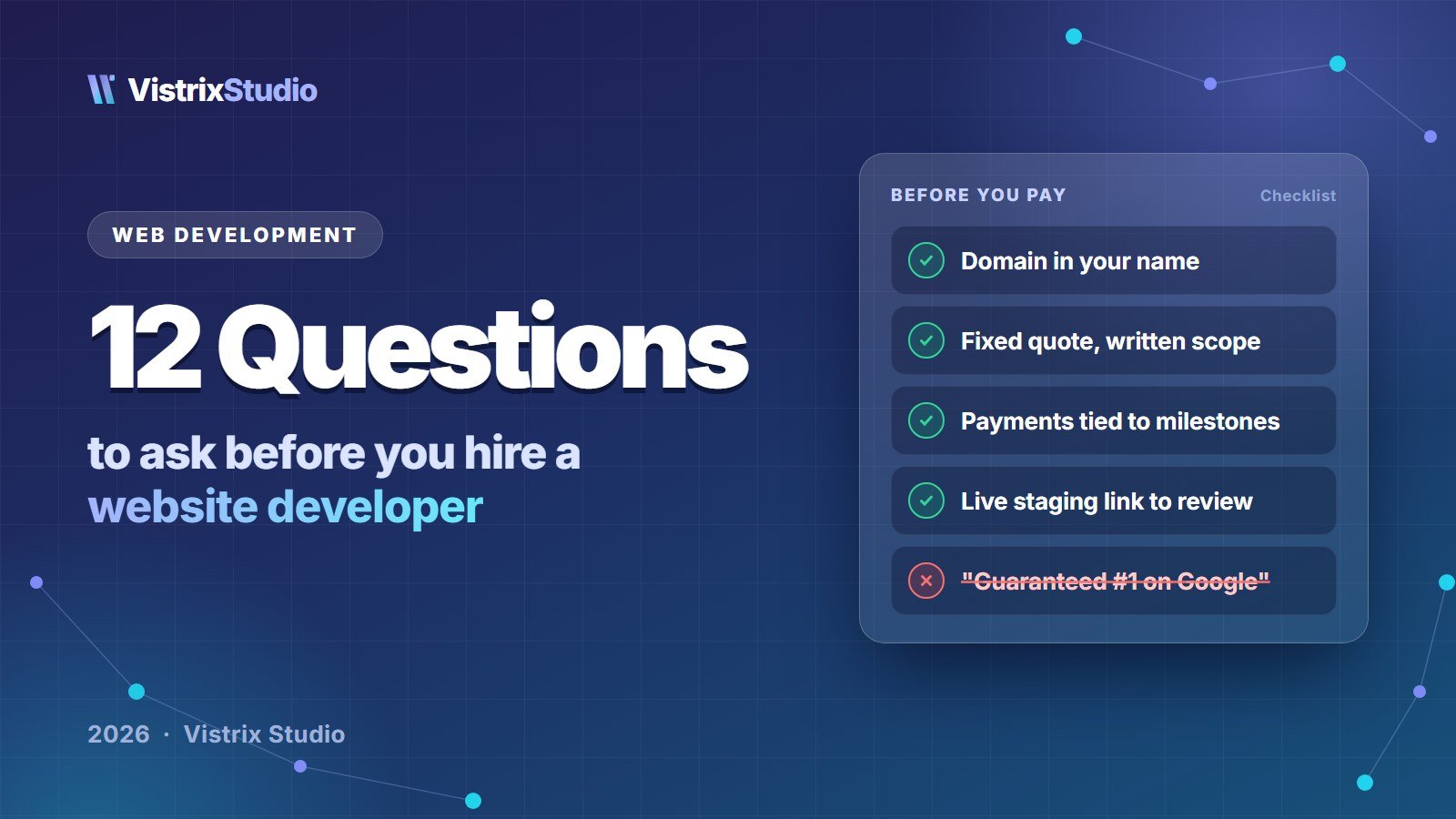
Whether you're hiring a freelancer, a local agency or a studio like ours, these are the 12 questions worth asking: what a good answer sounds like, and the warning signs that should make you walk away. Keep this page open on the call.
1. Can I See Live Websites You've Built, and Speak to a Past Client?
Screenshots and design mockups prove someone can design. Live websites prove they can deliver. Ask for three or four links and open them on your phone, because that's where most of your customers will see your site. Check whether they load quickly, whether the contact form works, and whether the sites are still online and looked after.
Then ask to speak to one past client. A developer with happy clients will connect you within a day. Ask that client one question: "Would you hire them again?" The pause before the answer tells you a lot.
2. Will the Domain, Hosting and Code Be in My Name?
This is the most important question on the list. A common pattern: the developer registers your domain on their own account "to make it easy", and two years later, when you want to switch, you discover you don't own your own web address. Before you pay, make sure that:
- The domain is registered in your name, with your email, on an account you can log into
- Hosting is on an account you own (your developer can be added as a user)
- You get the admin login for the website itself: WordPress, Shopify or whatever it's built on
- You own the design and code once the final payment is made, and that's written down
- Google Analytics, Search Console and your Google Business Profile belong to your Google account
If you can't log in to it, you don't own it. Everything else on this list can be fixed later; this one often can't.
3. Is This a Fixed Quote, and What Exactly Is Included?
A one-line quote that just says "Business website" is an invitation to surprise invoices. Ask for a written scope that lists:
- The number of pages, and what goes on each one
- How many rounds of design revisions are included
- Who writes the text and who supplies the photos
- Every feature: contact form, WhatsApp button, blog, booking, payments
- Third-party costs such as domain, hosting, email, premium themes and plugins, and who pays them every year
- What counts as a "change request" once the scope is signed off, and how it's priced
Then ask the reverse: "What is not included?" A good developer answers instantly. If you're comparing quotes, compare the scope, not just the final number. As a reference, our pricing page lists exactly what each package includes and excludes.
4. How Are Payments Split?
Paying the full amount upfront removes your only leverage. A fair structure ties each payment to something you can actually see: an advance to book the project, a payment when you approve the design, and the balance at launch. Larger projects are often split by phase, with an installment at each one.
Keep a record of every payment. Pay by bank transfer or UPI, and get an invoice or receipt each time, so there's never a dispute about what has been paid for.
5. What's the Timeline, and What Could Delay It?
As a rough guide, a simple five-page website usually takes two to three weeks. A custom-designed business website takes four to six weeks, and e-commerce stores or custom web apps take longer. Be wary of anyone promising a full custom site in a few days.
The most common cause of delay usually isn't the developer. It's waiting for content: the text, the photos, the product details. Ask what they need from you and by when, and put both sides' deadlines in writing.
6. Will I See Progress Before Launch?
Ask for a staging link: a private copy of your site where you can watch it come together and give feedback every week. A "big reveal at the end" is how people end up with a website they don't like and a developer who considers the job finished.
Also ask to approve the design before development starts, usually as mockups in a tool like Figma. Changes are cheap at the design stage and expensive once the site has been built.
Already have a website? Find out how it's really doing.
Before you replace or redesign anything, get a free Digital Health Audit. We check speed, SEO, security, AI-search readiness and how enquiries reach you, and send a clear report within 24 hours.
Get Your Free Audit →7. Can I Update the Website Myself?
You'll want to change prices, add products, post offers and update your timings. Ask which parts you can edit yourself, how, and whether they'll show you. A short handover session or screen recording is a good sign. If every text change needs the developer, you're signing up for a permanent dependency, and a bill for every small edit.
Not every site needs an editing system. A simple brochure site can work perfectly well with occasional updates done for you. Just make sure you know which one you're buying.
8. How Fast Will It Load on a Phone?
Most of your visitors will arrive on a mid-range Android phone over mobile data, and a slow site loses them before they read a word. Ask how the developer keeps sites fast, then check for yourself: run one of their live sites through Google PageSpeed Insights (pagespeed.web.dev). It's free and takes a minute. Ask for a speed target in writing for your own site.
Speed is one of the quiet reasons websites lose customers. We covered the others in why your website is losing customers.
9. What SEO Is Included, and What Isn't?
Every new website should launch with the technical basics done: a unique title and description on every page, clean URLs, a mobile-friendly layout, image descriptions, structured data, a sitemap submitted to Google Search Console and, if you're replacing an old site, redirects so you don't lose the rankings you already have.
Ongoing SEO is usually separate: content, local SEO, reviews, and visibility in AI answers. If local customers matter to you, read how to rank on Google Maps; for AI search, see how to get cited by ChatGPT, Perplexity and Gemini.
One hard rule: anyone who guarantees a #1 ranking on Google is either misunderstanding SEO or misleading you. Google's own guidance on hiring an SEO says plainly that no one can guarantee a #1 ranking.
10. How Do You Handle Security and Backups?
Small business sites get hacked far more often than owners expect, usually through outdated software or weak passwords. Ask about each of these:
- SSL (the padlock and https) included, and set to renew automatically
- Regular backups, and you know how a backup gets restored
- Software, themes and plugins kept up to date, especially on WordPress
- Spam protection on your contact forms
- Strong, unique admin passwords, never a shared "admin123"
- Form enquiries reaching an inbox or CRM you actually check
11. What Happens After Launch?
A website isn't a one-time purchase. It needs updates, backups and the occasional fix. Ask how long free support lasts after launch and what it covers, because fixing a bug is different from building something new. Ask whether there's a monthly maintenance plan, what's in it, and how quickly they respond if the site goes down. Get the answers in writing.
12. Who Exactly Will Build It, and What If You Disappear?
With a freelancer, you're relying on one person. With an agency, ask whether the work is done in-house or passed on to someone else. Neither is automatically wrong, but you should know who designs, who develops, and who your single point of contact is.
Then ask the slightly uncomfortable question: if you're unavailable for a month, what happens to my site? The right answer comes straight from question 2. Every login is in your name, the code is handed over, and any competent developer could pick it up.
Red Flags That Should Make You Walk Away
- "Guaranteed #1 on Google" or "guaranteed leads every month"
- Full payment upfront, with no written scope
- The domain or hosting will be "on our account for now"
- No live websites to show, only screenshots or templates
- A quote far below everyone else's, with renewal or maintenance charges appearing later
- Reluctance to hand over admin logins after the final payment
- Pressure to decide today: "this price is only valid till tonight"
How to Compare Quotes Side by Side
Put every quote you receive into a simple table like this one. The best quote is rarely the one with the lowest number. It's the one with the fewest gaps.
| Compare | What a good quote says |
|---|---|
| Ownership | Domain, hosting and admin logins in your name |
| Scope | Pages, features and revision rounds listed one by one |
| Content | Who writes the text and supplies photos, and by when |
| Timeline | A date for each phase, with both sides' responsibilities |
| Payments | Split across milestones you can see, not all upfront |
| Speed & SEO | A speed target and the SEO setup included at launch |
| After launch | A free support period, plus an optional maintenance plan |
| Yearly costs | Domain, hosting, email and plugin renewals, listed upfront |
A good developer will welcome every one of these questions. They've heard them before and have clear answers ready. If a question makes someone defensive, that's your answer.
Frequently Asked Questions
Should I hire a freelancer or an agency to build my website?
A freelancer can be a good fit for a small, simple site, as long as they have strong live work and you own every login. An agency or studio suits projects that need design, development, content and ongoing support together, and it reduces the risk of a single person becoming unavailable. Ask the same 12 questions either way.
Who should own my website's domain name?
You should. Register the domain in your name, with your email address, on an account you control. Your developer can be given access to manage it, but ownership should never sit with them.
How long does it take to build a small business website?
A simple five-page website usually takes two to three weeks. A custom-designed business website typically takes four to six weeks, and e-commerce stores or custom web applications take longer. Delays most often come from content arriving late, so agree on deadlines for both sides.
Is it safe to pay the full amount upfront?
It's better not to. A fair structure ties payments to milestones you can see: an advance to start, a payment when you approve the design, and the balance at launch. Always get a written scope, and an invoice or receipt for every payment.
What should a website quote include?
A written scope listing the pages, features and design revision rounds, who provides the content and photos, the timeline, the payment milestones, the support included after launch, and any yearly costs such as domain, hosting and plugin renewals.
Planning a new website?
At Vistrix Studio we answer all twelve of these in writing before we start: a fixed quote, a written scope, your domain in your name, milestone payments and a live staging link from week one. See what's included in each package, or tell us about your project.